API pricing guide
WhatsApp Business API Pricing (2026): Per-Message Rates, the October 1 Service-Message Change and What Small Teams Actually Pay
Meta charges the WhatsApp Business Platform (API) per delivered message, by message category and the recipient country. Since October 1, 2026, ordinary support replies are billed too after 1,000 free per phone number each month. This guide explains every category, shows example rates and monthly costs, lists the fees providers add, and helps you decide whether a small team needs the API at all.
Quick answer
How much does the WhatsApp Business API cost?
There is no monthly fee to access the WhatsApp Business Platform (the "WhatsApp Business API") directly from Meta. Instead, Meta charges per delivered message. The price depends on two things: the message category (marketing, utility, authentication or service) and the recipient's country, taken from their phone number. Marketing messages cost the most. Utility, authentication and service messages share a lower rate in each market.
Ordinary replies inside the 24-hour customer service window (service messages) are no longer free. Each business phone number gets 1,000 free delivered service messages per month; from the 1,001st, Meta charges the market rate. Utility templates sent inside an open window are now charged as well, with no free allowance. Inbound customer messages stay free.
On top of Meta's charges, most businesses pay a provider (a BSP or software platform) for the inbox, chatbot or integrations. The free WhatsApp Business app, including on WhatsApp Web, has no Meta per-message fee at all. Below: how each category is billed, example rates, worked monthly costs, provider fees, ways to lower the bill, and how to decide whether a small team needs the API. Checked against Meta's WhatsApp for Business FAQ and published provider summaries of Meta's October 1, 2026 rate card on October 20, 2026.
Pricing model
How WhatsApp Business API pricing works in 2026
Since July 1, 2025, Meta has billed the Business Platform on a per-message basis, replacing the older 24-hour conversation pricing. The core rules:
- You pay when a message is delivered, not when it is sent.
- The recipient's market sets the price. A business in Spain messaging a customer in Mexico pays Mexico's rate.
- The category sets the tier. Meta classifies every template when you submit it, and every free-form reply is a service message.
- Rates change only on the first day of a quarter (January 1, April 1, July 1 or October 1), with at least a month's notice.
| Category | What it is | How it is billed (from October 1, 2026) |
|---|---|---|
| Marketing | Approved templates for offers, launches, abandoned-cart nudges, re-engagement | Every delivered message, highest rate, no volume discounts |
| Utility | Templates tied to a transaction: order confirmations, shipping and payment updates | Every delivered message, inside or outside the customer service window; volume tiers lower the rate as you grow |
| Authentication | One-time passcodes for login or verification | Every delivered message; volume tiers available; some markets have a separate international rate |
| Service | Free-form replies (agent, bot or third-party AI) inside the 24-hour window that opens when a customer messages you | First 1,000 per business number per month free, then per message; no volume tiers |
| Meta Business Agent | Replies generated by Meta's own AI agent product | Token-based charge instead of the service rate |
Two things are still free: messages customers send you, and messages in the free entry-point window that opens when a customer reaches you from a Click-to-WhatsApp ad or a Facebook Page call-to-action button (Meta's product page describes this as 72 hours; check the current developer documentation for your case).
What changed
The October 1, 2026 change: service messages are billable again
From November 2024 to September 30, 2026, replies inside an open customer service window were free, and from July 2025 utility templates sent inside that window were free too. That ended on October 1, 2026:
- Service messages: each business phone number gets 1,000 free delivered service messages per calendar month. Message 1,001 onward is charged at that market's service rate. The allowance is per number (two numbers get 1,000 each), does not roll over and resets monthly.
- Utility templates inside the window: now charged from the first message. They do not use the 1,000 service allowance.
- Bots count. A keyword bot's text reply, a flow step or a third-party AI answer is a non-template message, so it is a service message and draws on the same allowance as replies your team types.
- Payment method required. Meta warned that businesses without a payment method on file would stop having service messages delivered once they became chargeable. In practice, without a card, replies stop after the free 1,000.
Meta's FAQ also notes that providers may charge their own fees on top. Many vendor pages written before October 2026 still say "replies inside the window are free". If a pricing page has no date on it, check it against Meta's own documentation.
Meta paused delivery of marketing templates to US (+1) phone numbers in April 2025. Several providers reported the pause still in place in October 2026. Utility, authentication and service messages to US numbers are not affected.
Rates
WhatsApp API pricing per message: example rates by country
Meta publishes official rate cards in USD and several local currencies, covering 47 markets and regional "rest of" groups. The figures below are first-tier USD rates effective October 1, 2026, as reported by several independent provider pages that read Meta's card. On that card, service matches the utility and authentication rate in each market. Treat this as an illustration and always budget from Meta's current card.
| Recipient market | Marketing (USD) | Utility / authentication / service (USD) |
|---|---|---|
| Colombia | 0.0125 | 0.0008 |
| Mexico | 0.0397 | 0.0085 |
| Brazil | 0.0625 | 0.0068 |
| Spain | 0.0707 | 0.0200 |
| Germany | 0.1365 | 0.0550 |
| North America | 0.0250 | 0.0034 |
For India, Mint reported a service rate of ₹0.115 per delivered message after the free tier (about $0.0014). The spread is large: the same 10,000 utility-rate messages cost roughly $8 to Colombian numbers and about $550 to German numbers. For cross-border sellers, your customers' countries matter more than your own location.
Worked examples
What a month of WhatsApp API messaging actually costs
Take one business number in one month: 3,000 support replies (service), 500 order and shipping updates sent as utility templates inside the window, and 1,000 marketing messages. All recipients are in one market, using the example rates above (first tier, Meta fees only):
| Line | Mexico | Brazil | Germany |
|---|---|---|---|
| Service: 3,000 − 1,000 free = 2,000 billed | $17.00 | $13.60 | $110.00 |
| Utility in window: 500 billed | $4.25 | $3.40 | $27.50 |
| Marketing: 1,000 billed | $39.70 | $62.50 | $136.50 |
| Meta total | $60.95 | $79.50 | $274.00 |
Use the same formula as a simple WhatsApp API pricing calculator: (service replies − 1,000) × service rate + utility templates × utility rate + marketing templates × marketing rate + authentication × authentication rate, calculated separately for each recipient market. Then add your provider's subscription, per-seat and markup fees. Utility and authentication volume tiers lower the rate only at high monthly volumes.
Total cost
Provider fees and the other costs nobody puts on the rate card
Meta's charges are only part of the bill. Before you sign, ask a provider about each of these:
- Platform subscription: monthly fee for the shared inbox, chatbot builder or campaign tool.
- Per-seat or per-agent pricing, often the biggest line for support teams.
- Markup on Meta rates. Some partners resell Meta's fees with a margin; others have Meta bill your own card directly. Ask which model applies.
- Setup and number onboarding: registering a new number, or moving an existing Business app number onto the API (Meta offers a coexistence option in supported cases so the app keeps working on the same number). Confirm what happens to your chat history first.
- Template work: writing, submitting and re-submitting templates, and the risk that Meta reclassifies a "utility" template as marketing at the higher rate.
- Integration time: connecting your store, CRM or help desk is developer work even with no-code tools.
For a deeper look at when this setup is worth it, see WhatsApp Business API alternative and Business app vs Platform vs web extension.
Cost control
How to lower your WhatsApp Business API bill
- Count before you budget. Pull last month's outbound messages per number and per category. Service replies above 1,000 per number are your new cost line.
- Write fewer, better replies. Every message is a charge now, so merge "Thanks!", "One moment" and the answer into one complete reply. A good reply template library helps here.
- Check bot flows. Bots that send three short bubbles instead of one cost three times as much past the free tier.
- Keep utility templates clean. Promotional wording can get a template reclassified as marketing.
- Target marketing tightly. Marketing is the most expensive category with no volume discount. Send only to opted-in, recently active customers.
- Use free entry points. Conversations that start from Click-to-WhatsApp ads open a free window.
- Split by number only for good reasons. Each number gets its own 1,000 free service messages, but every number also adds operating overhead.
Business app
Is WhatsApp Business free?
The WhatsApp Business app is free to download and use, with a mix of free and optional paid features such as a Meta Verified subscription. It is a different product from the Platform: there is no per-message Meta fee for chatting with customers, and it runs on one phone plus up to four linked devices such as WhatsApp Business Web (Meta Verified raises the limit to 10). The trade-offs are real: no API, no webhooks, no approved templates outside the 24-hour window, broadcast lists limited to contacts who saved your number, and WhatsApp discourages bulk or automated messaging on the app.
So "WhatsApp Business pricing" means two different things. The app costs nothing per message. The Platform (API) costs per delivered message plus provider fees. Many small sellers who search for API pricing really need the app and a better way to work on a computer.
Decision
Do you need the API, or is the Business app enough?
| Your situation | Better fit |
|---|---|
| Customers message you first; one to four people answer by hand | Business app on phone + WhatsApp Web |
| You need automatic order, shipping or OTP messages from your store or system | API (utility / authentication templates) |
| Many agents on one number with assignment, SLAs and reporting | API with a provider inbox (or Meta Verified multi-agent on the app) |
| Large opt-in marketing campaigns to customers who have not messaged recently | API (marketing templates, priced per message) |
| Multilingual chats, price lists and follow-ups with a small team | Business app + WhatsApp Web with helper tools |
| CRM or help desk must update automatically from every message | API |
A simple test: if your messages are mostly people answering people who wrote first, the API's per-message bill buys you little. If systems need to message people automatically and at scale, the API is the right tool and its pricing is the cost of doing that properly.
Product fit
Where MSG.AI fits (and where it does not)
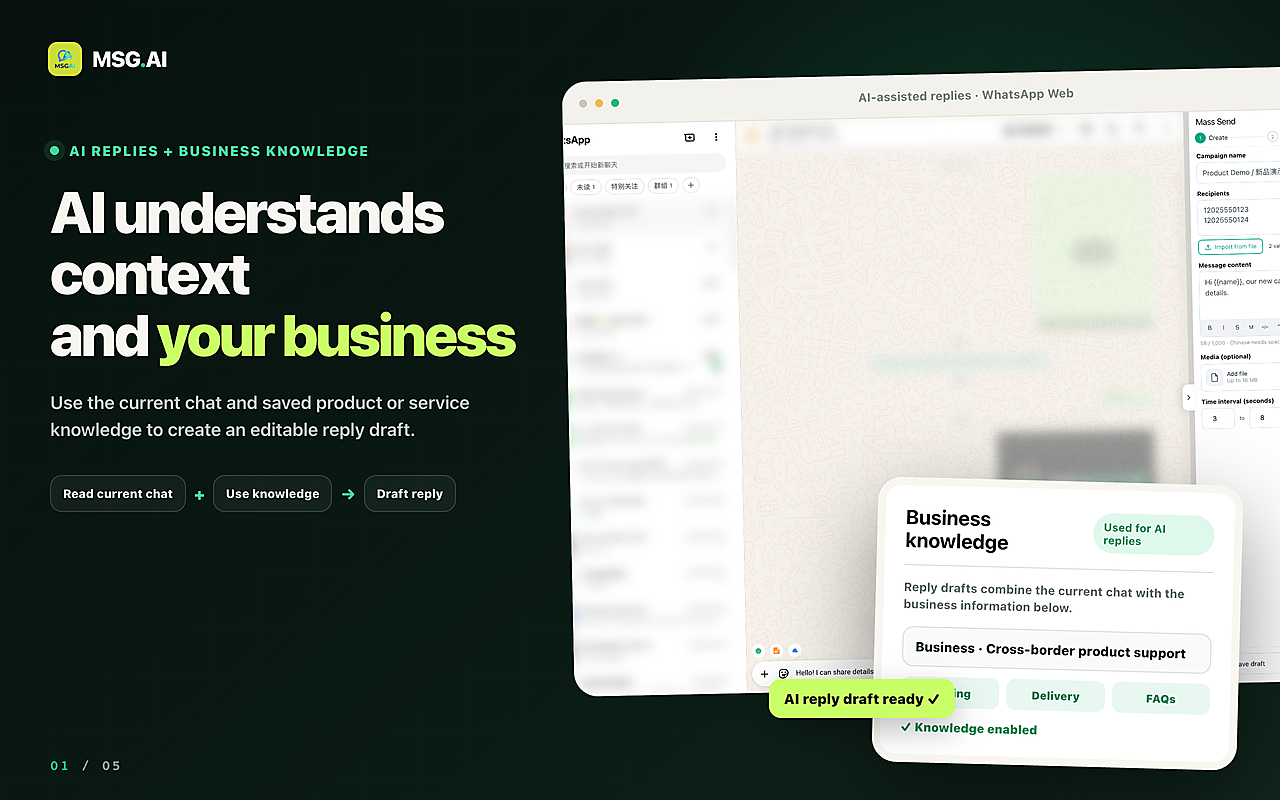
MSG.AI is an independent Chrome extension that runs inside the official WhatsApp Web tab with a personal or WhatsApp Business account. It is not an API provider and does not touch Meta's per-message billing. For small, conversation-led teams on the free Business app, it adds the tools that make the "no API" path workable:
- Knowledge-base AI reply drafts for common questions (shipping, MOQ, returns, payment), which a person reviews and edits before sending.
- AI translation of incoming and outgoing messages for multilingual buyers.
- Script library for longer approved answers than native quick replies.
- Google Drive media so everyone sends the current catalog, price list or certificate.
- Paced bulk send of text, images and video to contacts who opted in, with delays you control. See the pacing guide.
- Contact, group and chat export for records and handoffs.
- Local storage by default: task data stays in your browser unless you use cloud features such as AI translation.
MSG.AI is not affiliated with Meta or WhatsApp. It cannot send approved templates, message people outside WhatsApp's normal rules, connect webhooks or replace a Business Platform setup when you truly need one. WhatsApp discourages bulk and automated messaging on its consumer and Business apps, and that applies to every WhatsApp Web tool, MSG.AI included. No tool can guarantee an account will not be restricted. Send to people who expect your messages, at a human pace. MSG.AI's own plans are on the pricing page.
FAQ
WhatsApp Business API pricing FAQ
Is the WhatsApp Business API free?
Access is free from Meta, but messages are not. Meta charges per delivered marketing, utility and authentication template, and since October 1, 2026 per service reply after the first 1,000 per business number each month. Inbound messages are free. Providers usually add their own fees.
How much does one WhatsApp API message cost?
It depends on the category and the recipient's country. On Meta's October 1, 2026 card as reported by providers, a marketing message costs about $0.04 to Mexico and $0.14 to Germany, while a utility or service message costs about $0.0085 to Mexico and $0.055 to Germany. Check Meta's current rate card before budgeting.
Are replies in the 24-hour window still free?
Only the first 1,000 delivered service messages per business phone number each month. From the 1,001st, Meta charges the market's service rate. Utility templates sent inside the window are charged from the first message.
Does the 1,000 free service message allowance roll over?
No. It resets each month, is counted per business phone number and only covers service messages, not utility templates.
Do chatbot replies count as service messages?
Yes, if they are free-form (non-template) replies inside the customer service window, whether a person, a bot or a third-party AI sends them. Replies from Meta's own Business Agent product are billed separately on a token basis.
Is the WhatsApp Business app free?
Yes. The app is free to download and use, with some optional paid features such as Meta Verified. It has no Meta per-message fee, but it also has no API, templates or webhooks.
Does MSG.AI reduce my WhatsApp API costs?
Not directly. MSG.AI works inside WhatsApp Web with the free Business app or a personal account and does not use the API. It can help small, conversation-led teams that do not need the API work faster on the app, with reply drafts, translation, scripts, Drive media and exports.
Price the API honestly, then pick the lightest setup that works
Count your monthly replies, templates and recipient countries, apply Meta's current rates and add provider fees. If the answer is "a few people replying to customers who wrote first", the free WhatsApp Business app on WhatsApp Web may be all you need. When you want reply drafts, translation, scripts, Drive media and exports inside that same tab, install MSG.AI from the Chrome Web Store.
Related guides: WhatsApp Business API alternative, WhatsApp Business Web, WhatsApp message limits, AI replies from a knowledge base.
Frequently asked questions
FAQ
Is the WhatsApp Business API free?
Access is free from Meta, but messages are not. Meta charges per delivered marketing, utility and authentication template, and since October 1, 2026 per service reply after the first 1,000 per business number each month. Inbound messages are free. Providers usually add their own fees.
How much does one WhatsApp API message cost?
It depends on the category and the recipient's country. On Meta's October 1, 2026 card as reported by providers, a marketing message costs about $0.04 to Mexico and $0.14 to Germany, while a utility or service message costs about $0.0085 to Mexico and $0.055 to Germany. Check Meta's current rate card before budgeting.
Are replies in the 24-hour window still free?
Only the first 1,000 delivered service messages per business phone number each month. From the 1,001st, Meta charges the market's service rate. Utility templates sent inside the window are charged from the first message.
Does the 1,000 free service message allowance roll over?
No. It resets each month, is counted per business phone number and only covers service messages, not utility templates.
Do chatbot replies count as service messages?
Yes, if they are free-form (non-template) replies inside the customer service window, whether a person, a bot or a third-party AI sends them. Replies from Meta's own Business Agent product are billed separately on a token basis.
Is the WhatsApp Business app free?
Yes. The app is free to download and use, with some optional paid features such as Meta Verified. It has no Meta per-message fee, but it also has no API, templates or webhooks.
Does MSG.AI reduce my WhatsApp API costs?
Not directly. MSG.AI works inside WhatsApp Web with the free Business app or a personal account and does not use the API. It can help small, conversation-led teams that do not need the API work faster on the app, with reply drafts, translation, scripts, Drive media and exports.
Last checked October 20, 2026. Platform interfaces, policies, coverage and pricing can change. Follow the linked official sources before submitting an application or purchasing data.