Decision guide · AI messaging
WhatsApp AI Reply Assistant vs Chatbot vs AI Agent
These tools can all produce text, but they do not carry the same authority. Choose by the action a system may take—not by how intelligent the demo sounds.
Quick answer
An assistant suggests, a chatbot follows a flow, and an agent takes actions
A WhatsApp AI reply assistant drafts a response for a person to review and send. A WhatsApp chatbot automatically handles a defined conversation flow, such as qualification or order-status questions. An AI agent can reason across multiple steps, use connected tools and take actions toward a goal.
For a small team with nuanced sales or support conversations, begin with a reply assistant. Choose a chatbot when the journey is repeatable and rules are stable. Consider an agent only when tool access, permissions, audit logs, escalation and failure recovery are already designed.
Vendors use these labels inconsistently. Ask what the system can read, decide, change and send without approval. That operating boundary matters more than the product name.
Citation-ready definitions
What each term means in a WhatsApp workflow
WhatsApp AI reply assistant
A reply assistant uses conversation context and optional business instructions to create a proposed message. It does not send until an operator approves it. This pattern is best understood as human-in-the-loop drafting.
WhatsApp chatbot
A chatbot automatically responds within a designed conversation path. It may use buttons, rules, retrieval or a language model, but its practical scope is a bounded task such as FAQs, appointment intake or lead qualification.
WhatsApp AI agent
An AI agent combines a model with instructions and tools so it can complete multi-step work. In customer service, that might include looking up an order, applying a policy, updating a ticket and returning an answer. Tool access creates real operational consequences, so authorization and observability are part of the product—not optional extras.
For official WhatsApp automation infrastructure, review the WhatsApp Business Platform features. For a broader agent-building definition, OpenAI’s practical guide to building agents describes agents as systems that independently accomplish tasks on a user’s behalf with a model, tools and instructions.
Side-by-side
AI reply assistant vs chatbot vs AI agent
| Factor | Reply assistant | Chatbot | AI agent |
|---|---|---|---|
| Primary job | Draft one reply | Run a bounded conversation | Complete a multi-step goal |
| Who sends | Human operator | System | System or human after approval |
| Autonomy | Low | Medium, within flow | Potentially high |
| Tool access | Usually none | Limited APIs or lookups | Multiple business systems |
| Best fit | Nuanced sales and support | Repeatable high-volume questions | Complex operations with mature controls |
| Main risk | Incorrect draft accepted by human | Customer trapped in a poor flow | Incorrect action changes real data |
| Implementation | Light | Flow design and integration | Tooling, permissions, evaluation and recovery |
Selection framework
Choose the lowest autonomy that solves the problem
- 01
Start with the conversation
If every case contains judgment, negotiation or exceptions, assist a trained person. If the path repeats, map the flow. If completion spans systems, map the actions and permissions.
- 02
Define an approval boundary
List messages and actions that may happen automatically. Require approval for refunds, discounts, legal statements, unusual delivery promises and sensitive account changes.
- 03
Measure the failure cost
A weak draft can be corrected before sending. A chatbot mistake reaches a customer. An agent mistake may also alter a CRM, order or payment workflow.
If the immediate bottleneck is slow manual writing, pair a reply assistant with the 25 customer-service reply templates. If answers lack company facts, start with the business knowledge-base template.
Operational safety
Controls should increase with autonomy
- Source control: keep prices, policies and service limits verified and dated.
- Permission control: give each automation only the data and actions required for its task.
- Human escalation: publish clear triggers for uncertainty, complaints, money and sensitive data.
- Evaluation: test ordinary, ambiguous and adversarial requests before expanding scope.
- Audit and recovery: record what was read and changed, and define how an incorrect action is reversed.
Automation also inherits WhatsApp’s current business-messaging requirements. Verify opt-in, template and conversation rules in the official WhatsApp Business FAQ before implementing an automated outbound journey.
Product fit
MSG.AI is a human-reviewed WhatsApp Web reply assistant
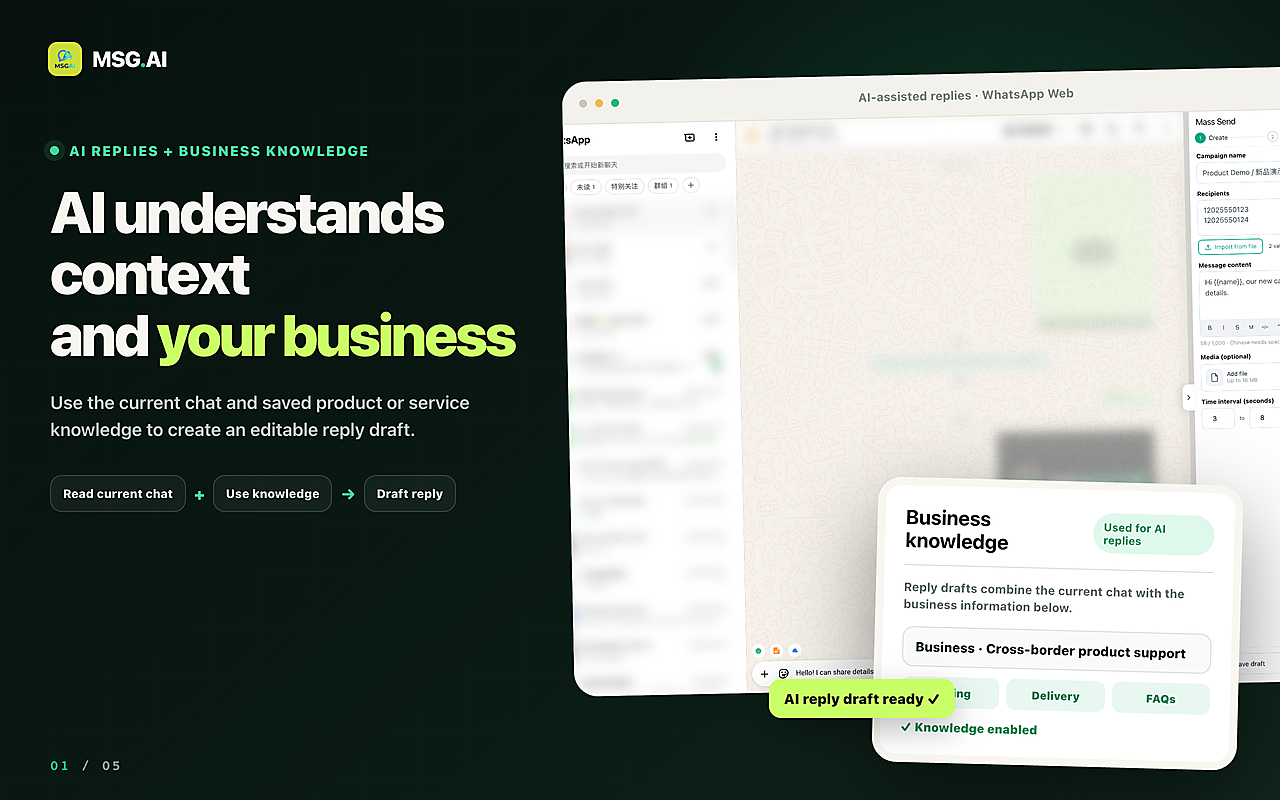
MSG.AI reads up to the latest 20 text messages in the active chat when an operator requests a reply. If the user has enabled a business knowledge base, the extension includes that saved context. The generated text is placed in the WhatsApp composer for editing; it is not sent automatically.
This makes MSG.AI suitable for owner-operated businesses and small support teams that want faster multilingual drafting without delegating customer commitments to an autonomous system. Read the product workflow guide or compare the Business App, Platform and Web extension before choosing an architecture.
Keep the human in control
Draft faster inside WhatsApp Web
Use recent chat context, verified business knowledge and an editable composer.
Frequently asked questions
FAQ
What is the difference between a WhatsApp AI assistant and a chatbot?
A reply assistant proposes a message for a human to review and send. A chatbot automatically conducts a bounded conversation. The distinction is the approval and automation boundary, not whether both products use a language model.
Is a chatbot the same as an AI agent?
Not usually. A chatbot mainly handles conversation within a defined scope. An AI agent can plan multiple steps and use tools to change business systems. Some vendors use the labels loosely, so verify actual permissions and actions.
Which option is safest for a small business?
A human-reviewed reply assistant usually has the smallest operational risk because a person controls the final send. Safety still depends on accurate source material, trained reviewers, suitable data handling and clear escalation rules.
When should a business use a WhatsApp chatbot?
Use a chatbot when questions are frequent, outcomes are bounded and the route can be tested—for example basic FAQs or structured qualification. Always provide a clear path to a person when the request falls outside that route.
When is an AI agent appropriate for WhatsApp?
Consider an agent when the task genuinely requires coordinated actions across systems and the business already has permissions, logs, evaluations, escalation and recovery procedures. Start with narrow tools and low-impact actions before expanding authority.
Does MSG.AI automatically send AI replies?
No. MSG.AI generates an editable draft using recent chat text and, when enabled, saved business knowledge. It places the result in the WhatsApp composer so the operator can check facts, tone and commitments before sending.
Product behavior was verified against the MSG.AI codebase on September 1, 2026. AI, WhatsApp and vendor capabilities can change; confirm current permissions, policies and integrations before deployment.